
ESD Mat Roll Guide Specs Installation and ANSI Compliance
Scaling up production lines while keeping sensitive components safe from electrostatic discharge is a major headache for electronics manufacturers. Buying pre-cut mats for dozens of unique workstations is expensive and inefficient. That is why sourcing a bulk esd matting roll is the smartest way to customize your static-safe areas.
However, not all rolls are created equal. To get the best ROI, you need to understand exactly what goes into high-quality ESD bench matting.

Material Science: Rubber vs. Vinyl/PVC
Choosing the right material for your esd rubber mat roll or vinyl roll impacts both durability and compliance.
| Feature | Rubber (Premium) | Vinyl / PVC (Standard) |
|---|---|---|
| Solder Iron Resistance | Excellent (Will not melt) | Poor (Melts upon contact) |
| Chemical Resistance | High (Resists oils, solvents, flux) | Low (Degrades with harsh chemicals) |
| Lifespan & Lay-Flat | Permanent stability; stays flat | Hardens and curls over time |
| Cost | Higher upfront investment | Lower initial cost |
For an automated or manual electronics assembly bench, dual-layer rubber matting is the industry standard due to its longevity and resilience.
Layer Construction Defined
A professional-grade esd table mat roll relies on a dual-layer construction to safely dissipate static charges.
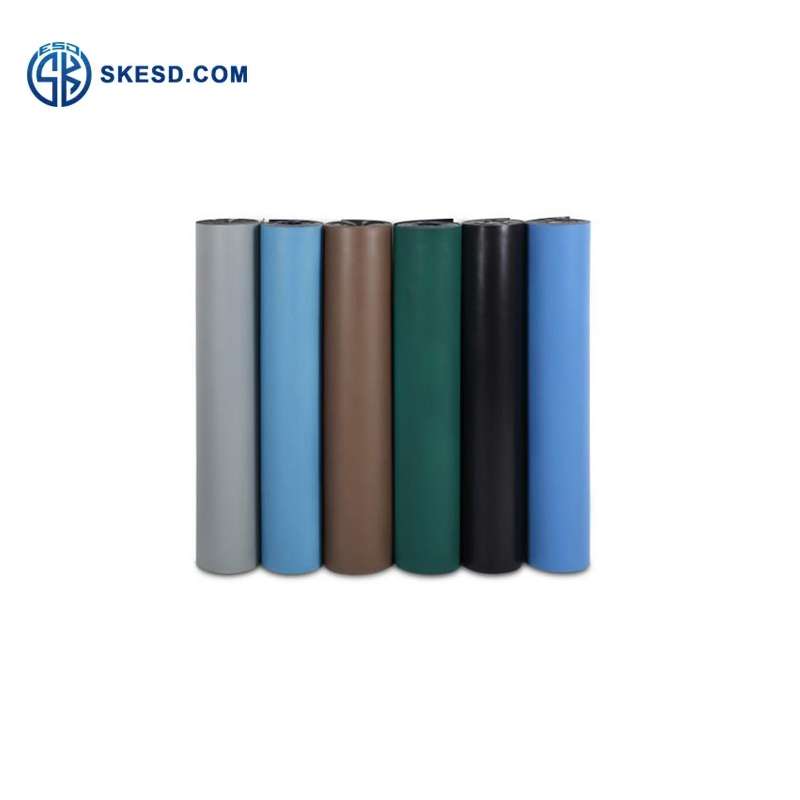
- Dissipative Top Layer: Usually colored (blue, green, or gray). This layer safely controls the speed of static discharge, slowing it down to prevent sudden arcs.
- Conductive Bottom Layer: Black back layer. This provides a fast, low-resistance path to ground, directing the static charge away from your sensitive components and safely into the grounding hardware.
Key Technical Specs to Check Before Buying
Before buying a bulk ESD roll, ensure the materials meet the strict ANSI/ESD S20.20 standard required for US electronics manufacturing. Check these metrics:
- Surface Resistivity (Top Layer): Should measure $10^6$ to $10^9$ ohms. This is the optimal static dissipative material range.
- Resistance-to-Ground (Rtg): Must be less than $1 times 10^9$ ohms to guarantee safe discharge.
- Thickness: Look for standard 0.060-inch (1.5mm) or 0.080-inch (2mm) options for reliable cushioning and wear resistance.
Matching ESD Matting Rolls to Specific Applications
Selecting the right esd matting roll isn’t a one-size-fits-all decision. Different areas of your facility face distinct physical demands and electrical risks. To maximize both safety and component protection, you need to match the material properties of your bulk roll to the specific tasks performed in each zone.
The Electronics Assembly Bench
The electronics assembly bench is the front line of static defense. Here, highly sensitive components are exposed during soldering, testing, and manual rework.
- Material Choice: A premium esd rubber mat roll is the gold standard for these workstations.
- Key Benefits: It features an essential solder iron resistance that prevents melting or off-gassing when hot tools accidentally make contact.
- Performance: The dissipative top layer drains static charges safely away from components, while the conductive bottom layer provides a reliable path to ground.
When configuring an anti-static workstation, maximizing organization is just as vital as static control; utilizing dedicated storage solutions like an adjustable esd pcb rack alongside your table mats ensures sensitive boards remain safe from physical and static damage throughout the assembly process.
Step-by-Step Guide: How to Properly Cut and Install Bulk ESD Rolls
Buying a bulk esd mat roll is the most cost-effective way to outfit multiple workbenches, but the material requires proper handling during installation to ensure long-term static control. If you do not install it correctly, you risk leaving sensitive components vulnerable to electrostatic discharge. Follow this direct, field-tested guide to prep, cut, and secure your roll like a pro.

Step 1: Acclimation and Measurement
Before making a single cut, unroll the material and let it sit flat at room temperature for at least 24 hours. Bulk ESD rolls are tightly wound at the factory, and the material needs time to relax and acclimate to your facility’s climate to prevent post-cut shrinking. Once relaxed, measure your workbench surfaces and add an extra $0.5text{ to }1text{ inch}$ to your total length measurements as a safety margin. Use a heavy-duty utility knife and a straight edge to make clean, straight cuts.
Step 2: Preparing the Worksurface
A clean foundation is critical for a secure fit. Thoroughly clean the existing tabletop to remove dust, grease, solder flux, and old adhesive residues. The bottom layer of your esd rubber mat roll must lay perfectly flat against the bench to prevent shifting and bubbling. If you are using heavy-duty mats that tend to slide, apply high-quality ESD-safe double-sided tape or a specialized dissipative adhesive to hold the corners firmly in place.
Step 3: Installing Grounding Hardware
An ungrounded mat is just an expensive piece of rubber. To create a true anti-static workstation, you must install grounding hardware on every cut piece:
- Placement: Punch a hole about $1text{ inch}$ from the corner of the mat where it will not interfere with daily work.
- Hardware: Install a $10text{mm}$ female snap fastener through the mat using a specialized crimping tool or a rivet press.
- Connection: Ensure the bottom metal flange makes direct, crushing contact with both the top static dissipative layer and the conductive bottom layer. Connect a grounding cord to this snap, then run the terminal end directly to your dedicated facility ground point or an ESD workbench ground block.
Step 4: Verifying the Connection
Important: Never assume a newly installed mat is working just because it looks right. Verification is the final, non-negotiable step before placing any electronics on the bench.
Use a calibrated surface resistivity meter to test the resistance-to-ground (Rtg) of the newly installed section. Place your test probes on the mat surface and verify that the resistance reads within the required $10^6 text{ to } 10^9 text{ ohms}$ range specified by the ANSI/ESD S20.20 standard. If you notice a high resistance reading or a completely open circuit, inspect the snap hardware immediately to ensure it is making tight contact with the internal conductive layers. For specialized layouts where you might need to cut customized intricate shapes out of textured mats, using a surface textured ESD mat as your roll foundation provides an excellent non-slip surface while maintaining these identical grounding procedures.
Maintenance and Longevity: Keeping Your ESD Mat Roll Compliant
Investing in a high-quality esd mat roll is only half the battle. To keep your anti-static workstation fully compliant with ANSI/ESD S20.20 standards, you need a strict maintenance routine. Over time, dust, solder flux, and skin oils create an insulative layer that compromises the surface resistivity of your mats, turning a safe dissipative zone into a static hazard.

The Hidden Danger of Standard Cleaners
Never use off-the-shelf household cleaners or window sprays on an esd rubber mat roll. Regular soap and commercial cleaners frequently contain silicone, wax, or abrasive solvents. These ingredients leave behind a non-conductive residue film that seals the static dissipative material, completely destroying its ability to path static charges to the ground.
Best Practices for Cleaning
To extend the lifespan of your esd bench matting roll and maintain top-tier performance, stick to a dedicated cleaning regimen:
- Daily Maintenance: Wipe down the surface with a lint-free clean room microfiber wiper slightly dampened with a specialized, silicone-free ESD mat cleaner to remove topical dust and debris.
- Weekly Deep Clean: Apply an ESD-safe cleaner generously to strip away heavy flux residues, grease, and grime without degrading the solder iron resistance of the rubber.
- What to Avoid: Avoid heavy scrubbing with abrasive pads, and never use isopropyl alcohol (IPA) in high concentrations on vinyl mats, as it can leach plasticizers and cause cracking.
Routine Testing Schedules
You cannot manage what you do not measure. Regular compliance verification ensures your workspace remains protected against ESD events.
| Testing Frequency | Target Area | Tool Required | Acceptable Range |
|---|---|---|---|
| Daily | Visual check of grounding hardware and wrist strap connections | Visual inspection | Secure, no loose snaps |
| Monthly | Surface-to-Ground resistance (Rtg) | Megohmmeter / Surface Resistivity Kit | $10^6$ to $10^9$ ohms |
| Quarterly | Surface-to-Surface resistance (Rtt) | Concentric ring or 5lb electrodes | $10^6$ to $10^9$ ohms |
If a section of your esd table mat roll consistently tests above $10^9$ ohms even after a thorough cleaning, that section has reached the end of its service life and must be replaced immediately.
Why Sourcing Your Bulk ESD Matting from SKESD Makes Business Sense
When you are managing a large-scale production floor or outfitting multiple workstations, buying pre-cut mats just doesn’t make financial or logistical sense. Investing in a high-quality esd mat roll from SKESD allows you to control your inventory, minimize waste, and ensure consistent static protection across your entire facility. We manufacture our bulk rolls to meet the strict demands of the United States electronics manufacturing sector, delivering commercial-grade reliability directly to your floor.

Uncompromising Quality Assurance
We know that a single static discharge can ruin thousands of dollars in sensitive components. That is why every SKESD esd rubber mat roll is manufactured under strict quality control protocols to guarantee reliable surface resistivity.
- Compliance Ready: Our matting fully aligns with the ANSI/ESD S20.20 standard, giving your QA teams complete peace of mind during audits.
- Built for Real Work: Engineered with premium dual-layer rubber matting, these rolls offer top-tier solder iron resistance that cheap vinyl alternatives simply cannot match.
- System-Wide Safety: To keep your technicians fully protected while handling sensitive boards, we highly recommend pairing our static-dissipative surfaces with our specialized carbon fiber ESD safety gloves for comprehensive grounding.
Customization & Availability
No two factory layouts are identical. Whether you need a standard bulk ESD roll 50ft in length or specific widths for unique workbench setups, we maintain a deep inventory to prevent lead-time bottlenecks.
| Feature | SKESD Bulk Roll Specifications |
|---|---|
| Material Options | Premium NBR Rubber / Durable Static Dissipative Vinyl |
| Layer Configuration | Dissipative top layer + Conductive bottom layer |
| Standard Lengths | 50 ft rolls with customizable width options |
| Colorways | Industry-standard Dull Green, Blue, and Gray |
Cost-per-Foot Efficiency
Financially, sourcing a bulk esd bench matting roll is the smartest move for growing operations. By cutting your own mats to size from a bulk roll, you drastically lower your upfront material costs and eliminate the premium price tag of pre-cut retail options. You get exactly the coverage you need for every anti-static workstation, shipping cart, and floor runway, maximizing your budget while maintaining a world-class ESD safety program.
FAQs About ESD Mat Rolls
How often should I test my ESD table mat roll?
You should test your ESD table mat roll daily if it is used in high-traffic production lines, or at least weekly for standard anti-static workstations. Regular testing ensures the mat maintains its static dissipative properties and complies with ANSI/ESD S20.20 standard requirements. Use a surface resistance meter to check the top-to-ground resistance consistently.
Can I use regular soap to clean an ESD rubber mat roll?
No, you should never use regular soap, household detergents, or window cleaners on an esd rubber mat roll. Standard cleaners leave behind an insulative chemical residue that seals the surface, destroying its ability to dissipate static charges. Always use a dedicated, residue-free ESD mat cleaner to maintain the integrity of the material.
Is a 2-layer mat better than a single-layer mat?
Yes, a dual-layer rubber matting structure is superior to a single-layer mat for electronics manufacturing. A high-quality 2-layer mat features a dissipative top layer to safely discharge static electricity from components and tools, paired with a conductive bottom layer that provides a quick path to the grounding hardware. Single-layer mats often lack this rapid, reliable path to ground.
What is the standard length for a bulk ESD roll?
The standard industry length for a bulk ESD roll is typically 50ft. Purchasing a bulk ESD roll 50ft in length provides excellent cost-per-foot efficiency and allows facility managers to custom-cut custom sizes for multiple workbenches and shipping carts. For specialized applications like cleanroom electronics assembly, we recommend sourcing a high-durability 2-sides textured RoHS2 ESD rubber mat to ensure maximum compliance and protection across your entire floor plan.


